What Is a Story Bible (And Why Every Novelist Needs One)
Professional TV writers have used story bibles for decades. Here's why every novelist needs one — and how to build yours from scratch.
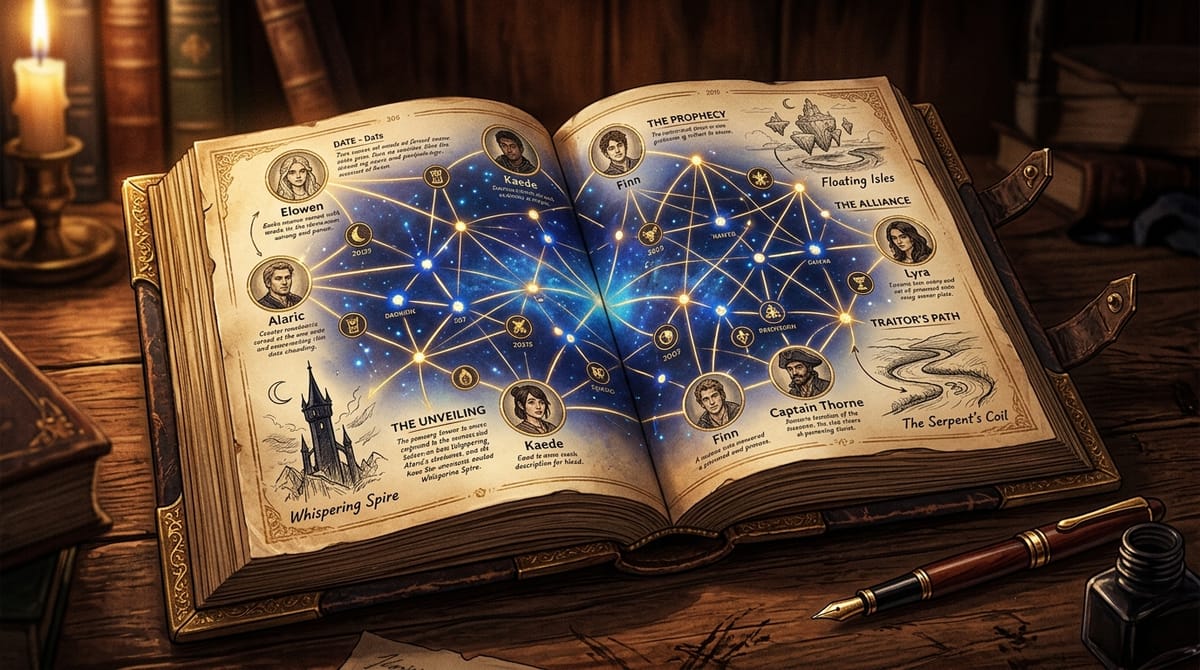
You're 40,000 words into your novel when you realize something terrible: your protagonist's eyes were green in chapter two and blue in chapter twelve. Her best friend's name was Sarah in the first act and Sara in the third. The café where they always meet was on Maple Street, except in that flashback where it was on Oak Avenue.
Sound familiar? You're not a bad writer. You're a writer without a story bible.
What Is a Story Bible?
A story bible — also called a series bible, novel bible, or show bible — is a comprehensive reference document that captures every important detail about your fictional world. Think of it as your novel's encyclopedia, style guide, and continuity bible rolled into one.
The concept comes from television writing. When a show has a writers' room with dozens of people writing different episodes, they need a shared source of truth. The story bible ensures that a character's backstory, a location's layout, or a world's rules stay consistent no matter who writes the episode.
Novelists face the same challenge — except the "writers' room" is just you, separated by weeks or months between writing sessions. Your memory is the weak link.
What Goes in a Story Bible?
A well-built story bible typically includes:
Characters
- Full profiles: Name, age, physical description, personality traits, backstory, motivations, fears, speech patterns
- Relationships: How characters relate to each other, history between them, power dynamics
- Character arcs: Where they start emotionally, what changes them, where they end up
- Voice notes: How this character speaks — formal or casual? Long sentences or fragments? Favorite expressions?
Settings
- Location profiles: Physical descriptions, atmosphere, sensory details, cultural context
- Maps and layouts: Spatial relationships between locations (even a rough sketch helps)
- Rules of the world: For fantasy/sci-fi — magic systems, technology levels, political structures, history
- Time and calendar: Seasons, holidays, how time works in your world
Plot and Structure
- Timeline of events: Both the in-story chronology and your narrative order
- Foreshadowing tracker: What you've set up and what needs payoff
- Subplot threads: Secondary storylines and where they intersect with the main plot
- Thematic notes: Core themes and how different plot threads explore them
Style and Tone
- POV rules: First person? Third limited? Whose head are we in and when?
- Prose style: Sentence rhythm, vocabulary range, level of description
- Tone guide: Dark and literary? Light and witty? Where on the spectrum?
- Genre conventions: Reader expectations you're meeting (and deliberately subverting)
Why Most Novelists Skip It (And Why That's a Mistake)
Let's be honest: building a story bible sounds like a lot of work. And it is — upfront. Most writers skip it for one of three reasons:
"I'm a discovery writer." You don't plan ahead; you write to find out what happens. A story bible feels like outlining, which kills your creative spontaneity. But here's the thing: a story bible isn't an outline. It's a record. Discovery writers need story bibles more than plotters, because you're creating details on the fly that you need to track.
"I'll remember." No, you won't. Not across 80,000 words and six months of writing. Not the color of a secondary character's hair. Not which hand your villain injured in act one. Trust the system, not your memory.
"It's too much work." Fair. Building a story bible from scratch is time-consuming. But fixing 47 continuity errors in revision is worse. A story bible is an investment that pays dividends every time you sit down to write.
How to Build a Story Bible: A Practical Guide
Start Simple
Don't try to build a complete story bible before you've written a word. Start with the essentials:
- Character sheets for your 3-5 main characters (name, age, physical description, core motivation, key relationships)
- Setting overview for your 2-3 primary locations
- Timeline of major plot events (even if it's rough)
Build as You Go
The real power of a story bible is that it grows with your novel:
- Finished a chapter? Update any new details you introduced.
- Created a new character? Add a quick profile.
- Made a worldbuilding decision? Log it immediately.
The five minutes you spend updating your story bible after each writing session will save you hours in revision.
Use the Right Format
Your story bible should be easy to update and easy to search. Options:
- A dedicated writing tool with built-in story bible features (best option — everything is linked)
- A wiki or Notion database (good for non-linear browsing)
- A structured document with a clear table of contents (minimum viable option)
- Index cards or a physical binder (works for some, but hard to search)
The best format is the one you'll actually use.
Make It Searchable
The whole point of a story bible is quick reference. If you can't find the detail you need in under 30 seconds, the format isn't working. Use consistent naming, headers, and tags.
The Story Bible in the Age of AI
Here's where things get interesting. If you're using AI tools to help with your writing — brainstorming, drafting, editing — a story bible becomes even more critical.
Why? Because AI tools suffer from context amnesia. A chatbot doesn't remember your character details from the last conversation. It doesn't know your world's rules. It doesn't know your style.
But if your AI writing tool integrates your story bible into every operation — feeding character profiles, setting details, and style notes into every generation, rewrite, and suggestion — the output transforms. Instead of generic AI prose, you get drafts that actually understand your world.
This is the difference between: - "Write a scene in a fantasy tavern" → generic fantasy tavern scene - "Write a scene in The Broken Compass tavern, where Kael (sardonic, guarded, hiding his noble birth) meets Seren (warm but calculating, speaks in metaphors) for the first time, in a world where magic is feared and practitioners are hunted" → a scene that actually fits your novel
A story bible makes the second prompt possible — automatically, for every AI interaction.
Story Bibles for Series Writers
If you're writing a series, a story bible isn't optional. It's survival equipment.
Across multiple books, you're tracking: - Characters who age, change, and accumulate history - A world that evolves with events from previous books - Relationships that shift across the arc - Subplots that span multiple volumes - Reader knowledge — what they know vs. what they don't
A shared story bible across your series ensures that book three doesn't contradict something you established in book one. And if you're using AI tools, a series-wide story bible means the AI understands the full context of your fictional world, not just the current chapter.
Start Your Story Bible Today
You don't need to build a comprehensive story bible before your next writing session. Start with this:
- Open a new document (or a dedicated tool)
- Write a one-paragraph profile for your protagonist
- Describe your primary setting in 3-5 sentences
- List the 5 most important events in your plot
Congratulations — you have a story bible. Now keep adding to it every time you write, and watch your consistency (and your confidence) grow.
Your future self, struggling to remember whether that secondary character had a scar on the left cheek or the right, will thank you.
ProseWeave's AI-integrated Story Bible feeds your characters, settings, and style into every AI operation — so your output stays consistent from chapter one to "The End." Try it free →