AI Writing Tools for Fiction Writers: What Actually Matters in 2026
The market is flooded with AI writing tools. Here's how to cut through the noise and pick one that actually helps you write better fiction.
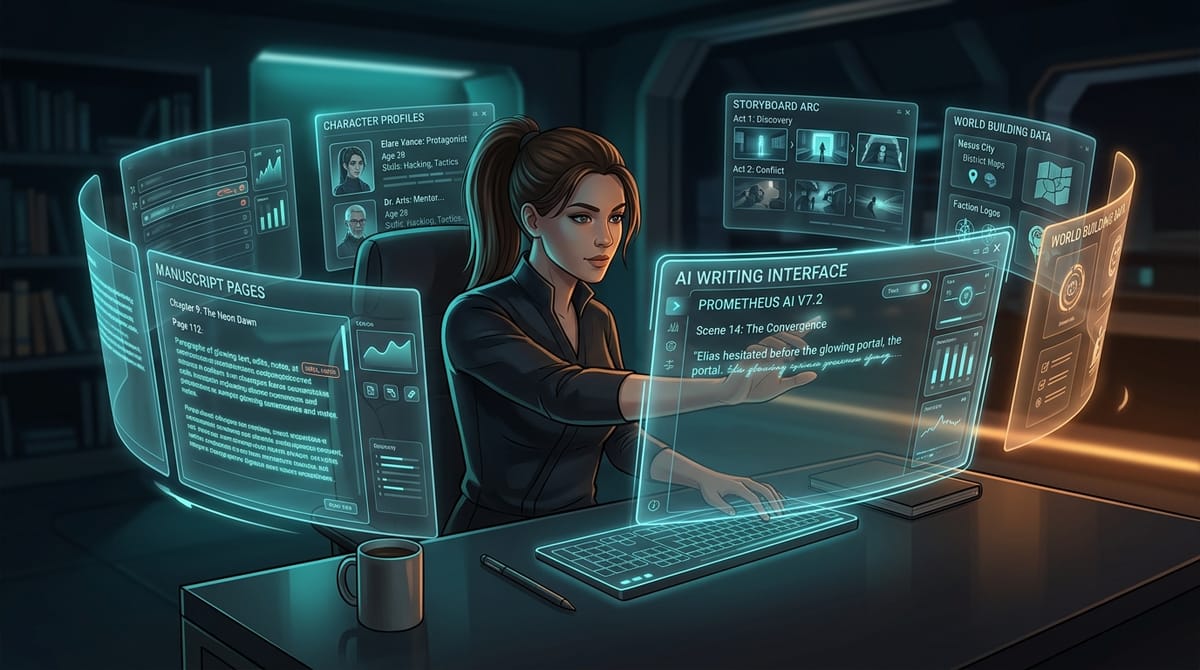
If you search for "AI writing tools" right now, you'll find hundreds of options. Content generators. Blog writers. Marketing copy tools. SEO assistants. And somewhere in that sea of productivity software, a handful of tools actually designed for fiction writers.
The problem? Most "AI writing tools" were built for marketers, not novelists. They optimize for speed and volume — churning out blog posts and ad copy — not for the deep, sustained, context-rich work of writing a novel.
Fiction is different. And fiction writers need different tools.
What Fiction Writers Actually Need
After years of AI tools entering the writing space, a clear picture has emerged of what actually matters for fiction writers. It's not what the marketing pages emphasize.
1. Story Memory (Not Just a Big Context Window)
The most important feature in an AI fiction writing tool — and the one most tools get wrong — is persistent story memory.
General-purpose AI tools process each request in isolation. You can paste context into the prompt, but there's a limit to how much fits, and managing that context manually is exhausting.
What fiction writers need is a tool that knows their story — characters, settings, themes, plot history — and automatically feeds that knowledge into every AI interaction. This is the difference between an AI that writes generic fantasy prose and one that writes prose set in your fantasy world with your characters.
What to look for: Story bible integration, character profiles that persist across sessions, automatic context injection into AI operations.
Red flag: Tools that require you to re-explain your story every time you start a new chat or scene.
2. Structure, Not Just Generation
The quickest way to write a bad novel with AI is to hit "generate" without a plan. The best AI fiction tools enforce some form of structure:
- Outlining — defining acts, chapters, and scene-level beats before generating prose
- Scene planning — specifying what happens, who's involved, and what changes, before the AI writes
- Progressive building — working from high-level structure down to detailed prose
This isn't about limiting creativity. It's about giving the AI (and you) enough structure to produce coherent, purposeful prose instead of meandering slop.
What to look for: Built-in outlining tools, scene beat editors, guided workflow from outline to manuscript.
Red flag: Tools where the primary interface is a text box with a "generate" button.
3. Visual Planning Tools
Novels are complex. They have multiple timelines, interwoven subplots, dozens of characters with evolving relationships, and settings that need spatial logic.
Spreadsheets and linear documents can't capture this complexity. Visual tools can:
- Corkboard/card views — scene cards you can rearrange and group
- Timeline views — your story's chronology laid out horizontally
- Relationship maps — character connections visualized as a graph
- Arc trackers — emotional or plot arcs charted across chapters
These aren't nice-to-haves. For any novel with moderate complexity, visual planning tools are how you see the shape of your story.
What to look for: Multiple visual views (not just a single corkboard), ability to link scenes to characters and settings, drag-and-drop reorganization.
Red flag: Tools with no visual planning at all, or a basic kanban board and nothing else.
4. Consistency Checking
Here's something most AI writing tools don't do: check their own work.
A tool that helps you generate 80,000 words but doesn't help you verify those words are consistent is only doing half the job. Fiction writers need:
- Continuity checking — catching contradictions in character details, settings, timelines
- Plot hole detection — identifying setups without payoffs and unresolved threads
- Timeline validation — ensuring events happen in a logical order
This is actually where AI shines. A language model can scan an entire manuscript and flag inconsistencies far faster than a human can — if the tool is built to do it.
What to look for: Automated consistency/continuity checking, plot hole scanning, timeline analysis.
Red flag: Tools focused entirely on generation with no review or analysis features.
5. Multi-Model Access
Not all AI models are equal, and different models excel at different tasks:
- Faster, cheaper models (like Claude Haiku) are great for brainstorming, outlining, and quick edits
- More capable models (like Claude Opus) produce richer, more nuanced prose for critical scenes
- Specialized fine-tunes can match specific genres or styles
The best tools let you choose the right model for the task, rather than locking you into one model for everything.
What to look for: Multiple model options, ability to switch models per task, transparent credit/usage system.
Red flag: Tools that hide which model they use or offer no choice.
6. Export Freedom
Your manuscript is yours. You should be able to take it anywhere.
What to look for: Export to standard formats (Markdown, DOCX, EPUB), full data export including story bible and notes, no lock-in.
Red flag: Tools where your only option is copy-pasting text out of the interface.
What Doesn't Matter (As Much As You'd Think)
"Unlimited" Generation
Some tools advertise unlimited AI generation. Sounds great until you realize that unlimited generation of mediocre, context-free text isn't actually useful. Quality and context matter more than volume.
The Latest Model
"Powered by GPT-5!" or whatever the newest model is. The model matters, but it's 20% of the equation. The other 80% is how the tool uses the model — what context it provides, what workflow it enforces, how it maintains consistency.
Grammar and Style Checking
You have Grammarly, ProWritingAid, or your editor for that. Your AI fiction tool should focus on the hard problems: story structure, character consistency, creative generation.
The Bottom Line
The AI writing tool landscape in 2026 looks very different from 2024. We've moved past the "AI will write your novel for you" hype into a more mature understanding: AI is a tool, and like any tool, its value depends on how well it's designed for the job.
For fiction writers, that means:
| Feature | Why It Matters |
|---|---|
| Story memory | AI output that sounds like your book, not a generic AI |
| Structured workflow | Coherent narrative, not aimless generation |
| Visual planning | See your story's shape at a glance |
| Consistency checking | Catch errors before your readers do |
| Multi-model access | Right tool for the right task |
| Export freedom | Your words, your format, no lock-in |
The tools that get these fundamentals right are the ones worth your time and money. Everything else is marketing.
ProseWeave is built around these exact principles — a Story Bible that feeds every AI operation, a structured outline-to-manuscript workflow, Canvas 2.0 visual planning, and a Consistency Checker that catches what you miss. See how it works →